Pipeline Risk Management Manual: Ideas, Techniques, and Resources, Third Edition
| Corrosion Threat | = (Atmospheric Corrosion) | 10% |
| + (Internal Corrosion) | 20% | |
| + (Buried Metal Corrosion) | 70% | |
| 100% |
| Corrosion Threat | |||
| A. | Atmospheric Corrosion | 0 10 pts | |
| A1. | Atmospheric Exposures | 0 5 pts | |
| A2. | Atmospheric Type | 0 2 pts | |
| A3. | Atmospheric Coating | 0 3 pts | |
| B. | Internal Corrosion | 0 20 pts | |
| B1. | Product Corrosivity | 0 10 pts | |
| B2. | Preventions | 0 10 pts | |
| C. | Subsurface Corrosion | 0 70 pts | |
| C1. | Subsurface Environment | 0 20 pts | |
| Soil Corrosivity | 0 15 pts | ||
| Mechanical Corrosion | 0 5 pts | ||
| C2. | Cathodic Protection | 0 25 pts | |
| Effectiveness | 0 15 pts | ||
| Interference Potential | 0 10 pts | ||
| C3. | Coating | 0 25 pts | |
| Fitness | 0 10 pts | ||
| Condition | 0 15 pts | ||
| Overall Threat of Corrosion | 0 100 pts |
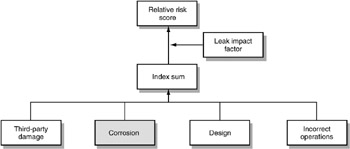
The potential for pipeline failure caused by corrosion is perhaps the most familiar hazard associated with steel pipelines. This chapter discusses how common industry practices of corrosion analysis and mitigation can be incorporated into the risk assessment model (see Figure 4.1). A detailed discussion of the complex mechanisms involved in corrosion is beyond the scope of this text.
Corrosion comes from the Latin word corrodere, meaning gnaw to pieces. Corrosion, as it is used in this text, focuses mainly on a loss of metal from pipe, although the concepts apply to many corrosionlike degradation mechanisms. From previous discussions of entropy and energy flow, we can look at corrosion from a somewhat esoteric viewpoint. Simply stated, manufactured metals have a natural tendency to revert to...