Return on Investment in Training and Performance Improvement Programs, Second Edition

The cost of providing training and performance improvement is increasing creating more pressure for HRD managers to know how and why money is spent. The total cost of training is required, which means that the cost profile goes beyond the direct costs and includes all indirect costs. Fully loaded cost information is used to manager resources, develop standards, measure efficiencies, and examine alternative delivery processes.
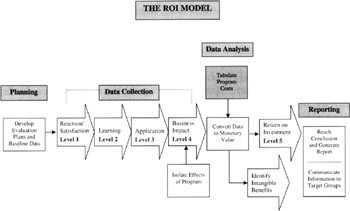
Tabulating program costs is an essential step in developing the ROI calculation, and these costs are used as the denominator in the ROI formula. It is just as important to focus on costs as it is on benefits. In practice, however, costs are often more easily captured than benefits. This chapter explores the costs accumulation and tabulation steps, outlining the specific costs that should be captured, and presents economical ways in which costs can be developed.
Many influences have caused the increased attention now given to monitoring training costs accurately and thoroughly. Every organization should know approximately how much money it spends on training and development. Many organizations calculate this expenditure and make comparisons with that of other organizations, although comparisons are difficult to make because of the different bases for cost calculations. Some organizations calculate training and development (T&D) costs as a percentage of payroll costs and set targets for increased investment. In the United States, the average is about 2%, whereas in Europe it is 3.0%, in Asia 3.8%, and in Latin America it is 3.8% (Marquardt, King,...