Return on Investment in Training and Performance Improvement Programs, Second Edition

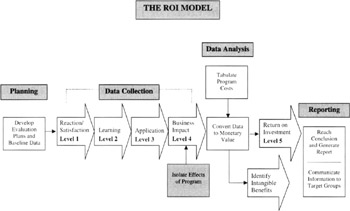
The following situation is repeated often. A significant increase in performance is noted after a major training program was conducted and the two events appear to be linked. A key manager asks, "How much of this improvement was caused by the training program?" When this potentially embarrassing question is asked, it is rarely answered with any degree of accuracy and credibility. While the change in performance may be linked to the training program, other nontraining factors usually have contributed to the improvement. As depicted in the ROI model above, this chapter explores the techniques to isolate the effects of training. These strategies are utilized in some of the best organizations because they attempt to measure the return on investment in training and development.
The cause-and-effect relationship between training and performance can be very confusing and difficult to prove, but can be accomplished with an acceptable degree of accuracy. The challenge is to develop one or more specific strategies to isolate the effects of training early in the process, usually as part of an evaluation plan. Upfront attention ensures that appropriate strategies will be used with minimum costs and time commitments.
While isolating the effects of training seems to be a logical, practical, and necessary issue, it is still much debated. Some professionals argue that to isolate the effects of training goes against everything taught in systems thinking and team performance improvement (Brinkerhoff and Dressler, 2002). Others argue that the...