Advanced Fluid Mechanics

Offering exceptional pedagogy, for both classroom use and self-instruction, this text integrates both the simple stages of fluid mechanics (Fundamentals) with those involving more complex parameters.
 TABLE OF CONTENTS
 To derive local equations that hold true at any point in our fluid, a volume of arbitrary shape is constructed and referred to as a control volume. A control volume is a device used in analyzing fluid flows to account for mass, momentum, and energy balances. It is usually a volume of fixed size, attached to a specified coordinate system. A control surface is the bounding surface of the control volume. Fluid enters and leaves the control volume through the control surface. The density and velocity inside and on the surface of the control volume are represented by ? and v. These quantities may vary throughout the control volume and so are generally functions of the spatial coordinates as well as time.
The mass of the fluid inside our control volume is ??? V ? dV. For a control volume fixed in space, the rate of change of mass inside of our control volume is

The rate at which mass enters the control volume through its surface is
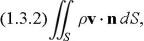
where ? v n dS is the mass rate of flow out of the small area dS. The quantity v n is the normal component of the velocity to the surface. Therefore, a positive value of v n means the v n flow locally is out of the volume, whereas a negative value means that it is into the volume.
The net...