Advanced Fluid Mechanics

Offering exceptional pedagogy, for both classroom use and self-instruction, this text integrates both the simple stages of fluid mechanics (Fundamentals) with those involving more complex parameters.
 TABLE OF CONTENTS
 A fluid is defined as a material that will undergo sustained motion when shearing forces are applied, the motion continuing as long as the shearing forces are maintained. The general study of fluid mechanics considers a fluid to be a continuum. That is, the fact that the fluid is made up of molecules is ignored but rather the fluid is taken to be a continuous media.
In solid and rigid body mechanics, it is convenient to start the geometric discussion of motion and deformation by considering the continuum to be made up of a collection of particles and consider their subsequent displacement. This is called a Lagrangian, or material, description, named after Joseph Louis Lagrange (1736 1836). To illustrate its usage, let ( X( X 0, Y 0, Z 0, t), Y( X 0, Y 0, Z 0, t), Z( X 0, Y 0, Z 0, t)) be the position at time t of a particle initially at the point ( X 0, Y 0, Z 0). Then the velocity and acceleration of that particle is given by
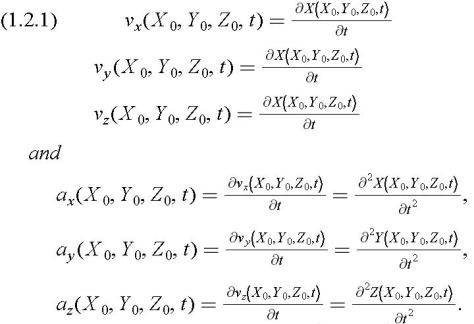
The partial derivatives signify that differentiation is performed holding X 0, Y 0 and Z 0 fixed.
This description works well for particle dynamics, but since fluids consist of an infinite number of flowing particles in the...