Advanced Fluid Mechanics

Offering exceptional pedagogy, for both classroom use and self-instruction, this text integrates both the simple stages of fluid mechanics (Fundamentals) with those involving more complex parameters.
 TABLE OF CONTENTS
 Stress is defined as a force applied to an area divided by that area. Thus, two directions are associated with stress: the direction of the force and the direction (orientation) of the area. Therefore, stress has a more complicated mathematical structure than does either a scalar or a vector. To put this into its simplest form, three special stress vectors will be introduced that act on mutually orthogonal surfaces whose faces are orientated with normals along our coordinate axes.
When a material is treated as a continuum, a force must be applied as a quantity distributed over an area. (In analysis, a concentrated force or load can sometimes be a convenient idealization. In a real material, any concentrated force would provide very large changes in fact, infinite changes both in deformation and in the material.) The previously introduced stress vector ? ( n ), for example, is defined as
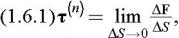
where ? S is the magnitude of the infinitesimal area. In the limit as ? S approaches zero the direction of the normal to ? S is held fixed.
It appears that at a given point in the fluid there can be an infinity of different stress vectors, corresponding to the infinitely many orientations of n that are possible. To bring order out of such confusion, we consider three very special orientations of n and then show that all other orientations of n produce stress vectors that are simply related to the first three.