Advanced Fluid Mechanics

Offering exceptional pedagogy, for both classroom use and self-instruction, this text integrates both the simple stages of fluid mechanics (Fundamentals) with those involving more complex parameters.
 TABLE OF CONTENTS
 When dealing with differential equations involving more than one dimension, it is important to know the classification of the equation, as the method of numerical computation must be tied to the behavior of the equation s solution. The three archetypical equations are the following:
Elliptic:

Parabolic:

Hyperbolic:
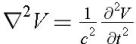
The wave equation is the most familiar form of hyperbolic equation. A propagation velocity c is associated with the time derivative. Thus, a disturbance of an existing condition at any point takes a finite time before its effect is noted at distant points. Whereas solutions of the other two classes tend to be smooth, hyperbolic equations can have abrupt discontinuities (shocks) in the solutions.
Parabolic equations are associated with diffusion processes such as heat, mass, and concentration diffusion. There is no wave speed associated with this, so mathematically a point an infinite distance from a place of change of conditions knows of the change instantly. The Prandtl boundary layer equations, wherein the x second derivative term is neglected, is frequently referred to as the parabolized Navier-Stokes equations, since the highest order of the stream-wise derivative is one.
The elliptic type of equation, of which Laplace s equation is the prime example, has each location communicating at all times with all other locations in the domain, as indicated by the mean value theorem that states that the value of the function at the center of a circle or sphere is the average of the values on the surface.