Advanced Fluid Mechanics

Offering exceptional pedagogy, for both classroom use and self-instruction, this text integrates both the simple stages of fluid mechanics (Fundamentals) with those involving more complex parameters.
 TABLE OF CONTENTS
 If temperature gradients exist in a flow, the momentum boundary layer for large Reynolds numbers discussed in Chapter 6 can be accompanied by a thermal boundary layer. Recall equation (1.14.7), where it was found from the first law of thermodynamics that

Taking u= c p T and q= ? k ?T for the internal energy and heat flux, and considering only cases where there is no internal heat generation and dissipation and compressibility effects are secondary, this becomes

Here, c p is the heat capacity at constant pressure ( J/kg K), and k is the thermal conductivity ( W/(m K).
Choose dimensionless parameters in the manner used for the flat plate in steady flow. Using the form
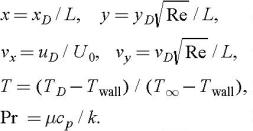
then equation (7.1.1) becomes

The resemblance to the form of equation (7.1.2) and the momentum equations of Chapter 6 suggest that similarity solutions are possible.
An important dimensionless parameter that comes up often in thermal flows is the Prandtl number, defined as Pr= c p /k. It represents the ratio of viscous diffusivity to thermal diffusivity. The Prandtl number is strictly a function of the properties of the fluid and not on flow properties and plays a strong role in determining the ratio of the thermal boundary layer to the momentum boundary layer. Representative Prandtl numbers are shown for various fluids in Tables 7.1.1, 7.1.2, and 7.1.3.
| Metal | Temperature (K) |
|---|