Advanced Fluid Mechanics

Offering exceptional pedagogy, for both classroom use and self-instruction, this text integrates both the simple stages of fluid mechanics (Fundamentals) with those involving more complex parameters.
 TABLE OF CONTENTS
 Because of the mathematical nonlinearities of the convective acceleration terms in the Navier-Stokes equations when viscosity is included, and also because the order of the Navier-Stokes equations is higher than the order of the Euler equations, finding solutions is generally difficult, and the methods and techniques used in the study of inviscid flows are generally not applicable. In this and the following chapters, a number of cases where exact and approximate solutions of the Navier-Stokes equations can be found are discussed.
In particular, for flows where the velocity gradients are perpendicular to the velocity, the convective acceleration terms vanish. The results are then independent of the Reynolds number. Several such cases will be considered.
Consider flow between parallel plates as shown in Figure 5.1.1. Write the velocity in the form v = ( u(y), 0, 0) which automatically satisfies the continuity equation. With gravity acting in the plane of the figure, the Navier-Stokes equations then become
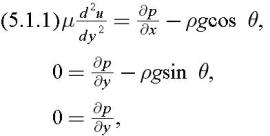
where ? is the angle between the x-axis and the direction of gravity. Since the viscous terms are functions of at most y, and since from the second and third equation p must be linear in y and independent of z ?p/ ?x must be a constant. Thus, integration of equation (5.1.1) gives

where c 1 and c 2 are...