Advanced Fluid Mechanics

Offering exceptional pedagogy, for both classroom use and self-instruction, this text integrates both the simple stages of fluid mechanics (Fundamentals) with those involving more complex parameters.
 TABLE OF CONTENTS
 Flows that occur at small values of the Reynolds number are important for studying the swimming of microorganisms, motion of small particles, determining the viscosity of suspensions, motion of glaciers, micro- and nanotechnology, and many other applications. The mathematical difficulties involved are somewhat subtler than those found in large Reynolds number flows but are fundamentally much the same.
For very small values of the Reynolds number Stokes (1851) proposed that the convective acceleration terms could be neglected and the Navier-Stokes equations replaced by
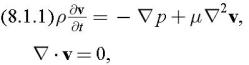
Taking the divergence of the first of equation (8.1.1) gives

and taking the curl gives

If the time dependence of the velocities is of the form e ?t, then it follows from equation (8.1.1) that

Since the pressure satisfies Laplace s equation, a particular solution of equation (8.1.4) is then

This is useful in solving for pressure once the velocity is known.
Stokes originally solved the problem of flow about a sphere in terms of the stream function. Lamb (1932) presented a general solution for the pressure in terms of a Taylor series. He also presented a general solution for the velocity in the form

Since attention will be restricted here to simple geometries, these three approaches are too complicated for our purposes. Instead, Stokes original solution supplies three fundamental solutions of equation (8.1.1): a doublet, a stokeslet, and a rotlet. [1]
1. Doublet. This is the same doublet as that found previously for irrotational inviscid flow namely,

Its velocity is...