Advanced Hypersonic Test Facilities

This book presents a number of new, innovative approaches to satisfy the enthalpy requirements for air-breathing hypersonic vehicles and planetary entry problems.
The detonation-driven shock tube, first proposed by Bird,3 has been studied by several investigators. 4 , 13 , 15 20 In a detonation-driven shock tube or shock tunnel, the conventional driver is replaced by a detonation section filled with a detonable gas mixture. Typically, an oxyhydrogen mixture is used as the driver gas with helium or argon dilution. Helium dilution raises the sonic speed in the driver gas and also somewhat reduces the danger associated with premature detonation.
Two modes of operation are possible. In the upstream-or backward propagation mode, the ignition source is just upstream of the primary diaphragm between the detonation and driven sections. In this case, the detonation wave propagates upstream. The corresponding wave diagram is shown in Fig. 3.
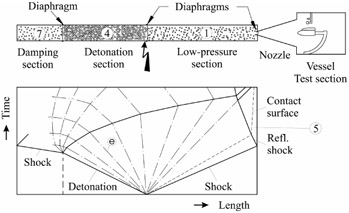
Direct initiation leads to a stable detonation wave where the products are at high temperature and pressure. The pressure rise following the detonation wave is constant, but the momentum imparted to the driver gas by the detonation wave is directed upstream, that is, opposite to the main flow. This leads to a reduction of the effective driver performance. Shortly after initiation, the main diaphragm opens and the burnt products exhaust into the low-pressure section, driving the incident shock that compresses and heats the test gas. A Taylor expansion immediately follows the detonation wave, decelerating the burnt gas to zero velocity along the characteristic labeled e in Fig. 3. This...

 TABLE OF CONTENTS