Advanced Hypersonic Test Facilities
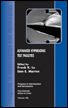
This book presents a number of new, innovative approaches to satisfy the enthalpy requirements for air-breathing hypersonic vehicles and planetary entry problems.
The detonation-driven shock tunnel TH2-D consists of a dump tank with a test section, a slender conical nozzle of 5.8 deg half angle and 586 mm exit diameter, a low-pressure section 15.6 m long, a detonation section of 9.4 m and a damping section 6.4 m long (see Fig. 6). The whole tube has an inner diameter of 140 mm, and its maximum working pressure is fixed at 150 MPa. A conventional helium driver operating with a double-diaphragm chamber is placed adjacent to the detonation driver. If necessary, the drivers can be exchanged within a day. Only one main diaphragm between the detonation and driven sections is used when operating the detonation driver. The detonable gas mixture is ignited by an initiation tube placed perpendicularly to the main tube a few centimeters upstream of the main diaphragm. The detonation section is filled with an oxyhydrogen mixture diluted with argon or helium. The mixing rate of the gases is controlled by thermal mass flow controllers. The combustion process in the detonation wave produces water vapor. To avoid its condensation in the test section during or shortly after a run, a fast-acting plug valve has been installed in front of the nozzle entrance. The closing mechanism of this valve is controlled by the incident shock. Until now, the detonation-driven shock tunnel TH2-D has been extensively calibrated for four test conditions listed in Table 2. The first two conditions relate to the...

 TABLE OF CONTENTS