Advanced Hypersonic Test Facilities
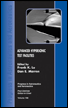
This book presents a number of new, innovative approaches to satisfy the enthalpy requirements for air-breathing hypersonic vehicles and planetary entry problems.
G. Russo [1], F. De Filippis [2], S. Borrelli [3], M. Marini [4], and S. Caristia [5]
CIRA, Centro Italiano Ricerche Aerospaziali, Via Maiorise, Capua, Italy
Copyright 2002 by CIRA. Published by the American Institute of Aeronautics and Astronautics, Inc., with permission.
The success of reusable launch and reentry spacecraft requires, among others, the development of well-characterized thermal protection systems (TPS). Through the Hermes spaceplane program, the European Space Agency (ESA) in the mid-1980s identified the need to have an adequate ground testing capability. One of the key elements of this capability was defined to be a large, high-enthalpy plasma wind tunnel (PWT) capable of testing and qualifying full-scale parts of the spacecraft.1
Because of the expressed willingness of Italy to participate in this effort and to have the facility installed within the national aerospace research center (CIRA), the conceptual, feasibility and preliminary design activities were assigned to CIRA and conducted between 1988 and 1989.1 It was at this stage that the need to have a stagnation temperature as high as 10,000 K was defined, requiring electric arc heating of the airflow. Because of such a high temperature, the development effort of the PWT was named SCIROCCO, the Italian word for the hot wind that originates in the Sahara and envelops the Mediterranean region from the southeast.
The detailed design effort was later conducted with the help of several specialized and internationally known designers, at the time when a Memorandum of Understanding (MOU)...

 TABLE OF CONTENTS