Advanced Hypersonic Test Facilities
This book presents a number of new, innovative approaches to satisfy the enthalpy requirements for air-breathing hypersonic vehicles and planetary entry problems.
This section introduces the JF-10 detonation-driven, high-enthalpy shock tunnel installed in the Institute of Mechanics, Chinese Academy of Sciences, Beijing, with special emphasis on forward detonation drivers, 3 7, 29 , 30 including research for improving them.12 , 13 , 21 , 31 Research related to the JF-10 can be traced back to 1957, when Yu proposed a detonation driver for hypersonic test facilities. JF-10 was set up in 1996 by modifying an old detonation-driven shock tube that was used for many years to explore detonation-driver techniques (Fig. 22).4 , 5 , 7 , 29 , 30 The tunnel's driver section is 150 mm in diameter and 10.15 m in length, and its driven section is 100 mm in diameter and 12.5 m in length. It was calibrated both in the forward- and backward-detonation modes. Experimental results indicated that attenuation of the incident shockwave is weak and the driving flow is uniform when it was operated in the backward-detonation mode for high Reynolds number testing. However, the driving pressure is only 40% of the C J pressure, and the kinetic energy of the detonation cannot be fully used. The performance for the forward-detonation mode is better, but there are also some limitations (as discussed previously). To minimize the effect of Taylor rarefaction, for example, an area converging section is incorporated in the design of the JF-10. The effect of this area converging section on driving flows is positive but, unfortunately, limited.
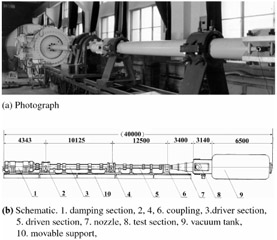

 TABLE OF CONTENTS