Advanced Hypersonic Test Facilities
This book presents a number of new, innovative approaches to satisfy the enthalpy requirements for air-breathing hypersonic vehicles and planetary entry problems.
Despite their simple operation, detonation-driven facilities are not yet common. To the authors' knowledge, only the facilities listed in Table 1 are in operation at the time of publication. To allow a quantitative judgement of the performance of the different operational modes, Lu et al.13 introduced the concept of an effective static driver pressure p e and sound speed a e for the propagating detonation products. The effective values are those of a conventional static driver that would deliver the same shock strength in a given shock tube. For the upstream mode, the effective conditions are on the characteristic e in Fig. 3 and they are13
| (9) |  |
| (10) |  |
where CJ indicates the C-J condition immediately behind the detonation wave and M 2,CJ is the local flow Mach number behind the detonation wave, that is, the flow velocity related to the sound speed for the C J condition. For the downstream mode the effective driver conditions are given by13
| (11) |  |
| (12) | 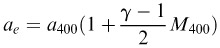 |
where the subscript 400 indicates the plateau values behind the Taylor rarefaction of the downstream-running detonation wave. The equations show that, as expected, the momentum of the downstream-running detonation products augments the pressure and sound speed relative to the static values. This leads to a better pressure recovery of facilities operating in the downstream mode. However, for most of the conditions, the downstream-running Taylor rarefaction leads to an unsteady behavior of the incident shock, which enhances shock attenuation from boundary-layer effects.
Figure...

 TABLE OF CONTENTS