Advanced Hypersonic Test Facilities
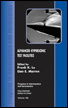
This book presents a number of new, innovative approaches to satisfy the enthalpy requirements for air-breathing hypersonic vehicles and planetary entry problems.
J. T. Best [1] Arnold Engineering Development Center, Arnold Air Force Base, TN
This material is declared a work of the U.S. Government and is not subject to copyright protection in the United States.
In 1992, the U.S. Air Force and NASA jointly conducted a study to assess U.S. test needs and capabilities for development of hypersonic flight systems that became a part of the joint NASA/Department of Defense (DoD) National Facilities Study reported in 1994.1 The results were confirmed in 1997 by the DoD Aeronautical Test Facilities Assessment study.2 These studies revealed serious gaps in hypersonic test capabilities relative to test needs for various types of hypersonic testing.
An especially important issue found in those studies is that the U.S. does not have test facilities that can be used for development testing of air-breathing propulsion flight systems at the necessary flight simulation conditions above Mach 8. Technologies are available for building development ground-test facilities for testing to Mach 7, but not beyond where some envisioned air-breathing systems would fly at speeds as high as Mach 20. It is critical that the environment of hypersonic flight be simulated and actually duplicated for most cases in terms of velocity, temperature, pressure, air chemistry, and structural thermal equilibrium in qualification and durability testing of air-breathing propulsion and other systems.
There are at least five major technical obstacles or issues to the development of higher Mach number (M > 7), true-temperature, hypersonic wind tunnels. They are: 1) providing sufficient energy...

 TABLE OF CONTENTS