Advanced Hypersonic Test Facilities

This book presents a number of new, innovative approaches to satisfy the enthalpy requirements for air-breathing hypersonic vehicles and planetary entry problems.
D. M. Smith [1], E. J. Feldermant [2], and F. L. Shope [3]
Sverdrup Technology, Inc., Arnold Air Force Base, Tennessee
and J. A. Balboni [4]
NASA Ames Research Center, Moffett Field, California
This material is declared a work of the U.S. Government and is not subject to copyright protection in the United States.
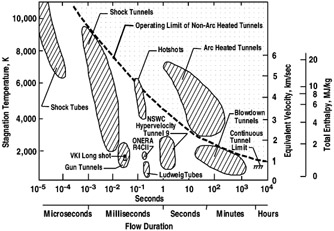
Hypersonic vehicles face rigorous thermostructural demands during endoatmospheric ascent, cruise, and reentry. Arc facilities are unique in their ability to reproduce thermal environments simulating flight from Mach 8 to 20 for the long exposure periods required to validate thermostructural performance and survivability of materials and components (Fig. 1). Such simulations typically require a test gas, usually air, heated to temperatures between 3000 and 10,000 K and supplied continuously for several minutes. Arc heaters provide an efficient, clean heating source for such simulations, and are flexible enough in their various configurations to enable aerothermal simulations for a large sector of the hypersonic velocity pressure altitude flight envelope. Consequently, arc heaters have found widespread use in both military and commercial aerospace applications for the development of high-temperature materials and structures for missiles, reentry vehicles, high-speed transports, military/civil space transportation and space access vehicles, scramjet combustors, and hypervelocity ordnance and munitions systems.1
[1]Senior Engineer.
[2]Engineering Specialist.
[3]Engineering Specialist.
[4]Research Engineer.
Electric arc heaters first came into use for aeronautical...

 TABLE OF CONTENTS