Fluid Mechanics, Fourth Edition
Guiding students from the fundamentals to the analysis and application of fluid mechanics, this text covers compressible flow and such diverse applications as hydraulics and aerodynamics.
 TABLE OF CONTENTS
 In fluid mechanics we need to deal with quantities of various complexities. Some of these are defined by only one component and are called scalars, some others are defined by three components and are called vectors, and certain other variables called tensors need as many as nine components for a complete description. We shall assume that the reader is familiar with a certain amount of algebra and calculus of vectors. The concept and manipulation of tensors is the subject of this chapter.
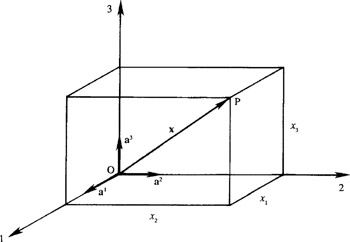
A scalar is any quantity that is completely specified by a magnitude only, along with its unit. It is independent of the coordinate system. Examples of scalars are temperature and density of the fluid. A vector is any quantity that has a magnitude and a direction, and can be completely described by its components along three specified coordinate directions. A vector is usually denoted by a boldface symbol, for example, x for position and u for velocity. We can take a Cartesian coordinate system x 1, x 2, x 3, with unit vectors a 1, a 2, and a 3 in the three mutually perpendicular directions (Figure 2.1). (In textson vector analysis, the unit vectors are usually denoted by i, j, and k. We cannot use this simple notation here because we shall use ijk to denote components of a vector.) Then the position vector is written as