Fluid Mechanics, Fourth Edition
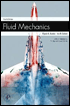
Guiding students from the fundamentals to the analysis and application of fluid mechanics, this text covers compressible flow and such diverse applications as hydraulics and aerodynamics.
 TABLE OF CONTENTS
 Consider steady laminar flow of a Newtonian fluid in a long, cylindrical, elastic tube of length L. The radius of the tube at any cross section is a=a(x). Poiseuille's formula for the flow rate is a good approximation in this case.
Develop an expression for the outlet pressure p(L) in terms of the higher inlet pressure, the flow rate  , fluid viscosity ?, and a(x)
For a pulmonary blood vessel, we may assume that the pressure-radius relationship is linear: 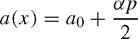 , where a 0 is the tube radius when the transmural pressure is zero and ? is the compliance of the tube. For a tube of length L, show that

where a( 0) and a(L) are the values of a(x) at x=0 and x=L, respectively.
For pulsatile flow in a rigid cylindrical tube of length ?, the pressure drop ? p may be expressed as: ? p=f(L, a, ?, ?, ?, U), where a is tube radius, ? is density, ? is viscosity, ? is frequency, and U is the average velocity of flow. Using dimensional analysis, show that

where C 1, C 2, C 3, and C 4 are constants, Re is Reynolds number, and St is Strouhal number defined as a ?/U
Localized narrowing of an artery may be caused by the formation of arthero sclerotic plaque in...