Fluid Mechanics, Fourth Edition

Guiding students from the fundamentals to the analysis and application of fluid mechanics, this text covers compressible flow and such diverse applications as hydraulics and aerodynamics.
 TABLE OF CONTENTS
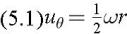
 Motion in circular streamlines is called vortex motion. The presence of closed streamlines does not necessarily mean that the fluid particles are rotating about their own centers, and we may have rotational as well as irrotational vortices depending on whether the fluid particles have vorticity or not. The two basic vortex flows are the solid-body rotation
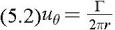
and the irrotational vortex
These are discussed in Chapter 3, Section 11, where also, the angular velocity in the solid-body rotation was denoted by ? 0 = ?/2. Moreover, the vorticity of an element is everywhere equal to ? for the solid-body rotation represented by equation (5.1), so that the circulation around any contour is ? times the area enclosed by the contour.
In contrast, the flow represented by equation (5.2) is irrotational everywhere except at the origin, where the vorticity is infinite. All the vorticity of this flow is therefore concentrated on a line coinciding with the vortex axis. Circulation around any circuit not enclosing the origin is therefore zero, and that enclosing the origin is ?. An irrotational vortex is therefore called a line vortex. Some aspects of the dynamics of flows with vorticity are examined in this chapter.
A vortex line is a curve in the fluid such that its tangent at any point gives the direction of the local vorticity. A vortex line is therefore related to the vorticity vector the same way a streamline...