Fluid Mechanics, Fourth Edition

Guiding students from the fundamentals to the analysis and application of fluid mechanics, this text covers compressible flow and such diverse applications as hydraulics and aerodynamics.
 TABLE OF CONTENTS
 The coordinates are (R, ?,x), where ? is theazimuthal angle (see Figure 3.1b, where ? is used instead of ?). The equations are presented assuming ? is a scalar, and

where i R, i ?, and i x are the local unit vectors at a point.
Gradient of a scalar

Laplacian of a scalar

Divergence of a vector

Curl of a vector

Laplacian of a vector

Strain rate and viscous stress (for incompressible form ? ij = 2 ?e ij)
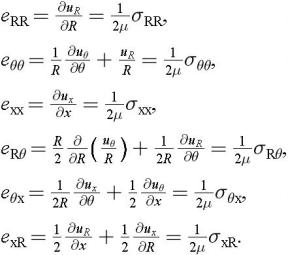
Vorticity ( ? = ? u)

Equation of continuity

Navier-Stokes equations with constant ? and ?, and no body force

where
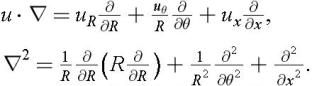
The plane polar coordinates are (r, ?), where r is the distance from the origin (Figure 3.1a). The equations for plane polar coordinates can be obtained from those of the cylindrical coordinates presented in Section B1, replacing R by r and suppressing all components and derivatives in the axial direction x. Some of the expressions are repeated here because of their frequent occurrence.
Strain rate and viscous stress (for incompressible form ? ij = 2 ?e ij)
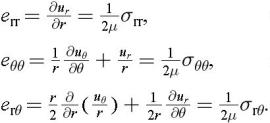
Vorticity

Equation of continuity

Navier-Stokes equations with constant ? and ?, and no body force

where

The spherical polar coordinates used are (r, ?, ?), where ? is the azimuthal angle (Figure 3.1c).