Fluid Mechanics, Fourth Edition

Guiding students from the fundamentals to the analysis and application of fluid mechanics, this text covers compressible flow and such diverse applications as hydraulics and aerodynamics.
 TABLE OF CONTENTS
 All fluid mechanics is based on the conservation laws for mass, momentum, and energy. These laws can be stated in the differential form, applicable at a point. They can also be stated in the integral form, applicable to an extended region. In the integral form, the expressions of the laws depend on whether they relate to a volume fixed in space, or to a material volume, which consists of the same fluid particles and whose bounding surface moves with the fluid. Both types of volumes will be considered in this chapter; afixed region will be denoted by V and a material volume will be denoted by  . In engineering literature a fixed region is called a control volume, whose surfaces are called control surfaces.
The integral and differential forms can be derived from each other. As we shall see, during the derivation surface integrals frequently need to be converted to volume integrals (or vice versa) by means of the divergence theorem of Gauss

where F( x, t) is a tensor of any rank (including vectors and scalars), V is either a fixed volume or a material volume, and A is its boundary surface. Gauss' theorem was presented in Section 2.13.
In deriving the conservation laws, one frequently faces the problem of finding the time derivative of integrals such as
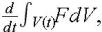
where F( x, t) is a tensor of any...