PRINCE2 Revealed: Including How to use PRINCE2 for Small Projects

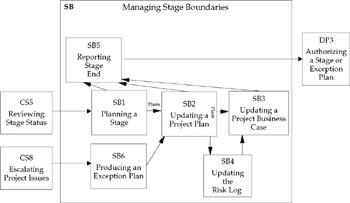
Managing Stage Boundaries (SB)


Figure 8: Top-level diagram (SB)

What does the process do?

  • Confirms to the project board which products planned to be produced in the current stage plan have been delivered.

  • Gives reasons for the non-delivery of any products which were planned (in the case of deviation forecasts).

  • Verifies that any useful lessons learned during the current stage have been recorded in the lessons learned log.

  • Provides information to the project board to allow it to assess the continued viability of the project.

  • Obtains approval for the next stage plan or the exception plan.

  • Ascertains the tolerance margins to be applied to the new plan.

Why?

The ability to authorize a project to move forward a stage at a time is a major control for the project board. There is also a need for a process to create a plan to react to a forecast deviation beyond tolerances. This process aims to provide the information needed by the project board about the current status of the project plan, business case and risks to judge the continuing worth of the project and commitment to a new plan.

SB1 Planning a stage

What does the sub-process do?

  • Prepares a plan for the next stage.

Why?

In order to adequately control a stage the project manager needs a plan in which the detailed activities go down to the level of a handful of days.

How?

  • Check the project approach for any guidance on how the products of the next stage are to be produced.

UNLIMITED FREE
ACCESS
TO THE WORLD'S BEST IDEAS

SUBMIT
Already a GlobalSpec user? Log in.

This is embarrasing...

An error occurred while processing the form. Please try again in a few minutes.

Customize Your GlobalSpec Experience

Category: Project Management Services
Finish!
Privacy Policy

This is embarrasing...

An error occurred while processing the form. Please try again in a few minutes.