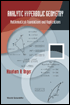
Analytic Hyperbolic Geometry: Mathematical Foundations and Applications
The reason for starting a book on analytic hyperbolic geometry with chapters on gyrogroups and gyrovector spaces is that some gyrocommutative gyrogroups give rise to gyrovector spaces just as some commutative groups give rise to vector spaces. Gyrovector spaces, in turn, algebraically regulate analytic hyperbolic geometry just as vector spaces regulate algebraically analytic Euclidean geometry. To elaborate a precise language we prefix a gyro to any term that describes a concept in Euclidean geometry to mean the analogous concept in hyperbolic geometry. The prefix gyro stems from Thomas gyration which is, in turn, the mathematical abstraction of a special relativistic effect known as Thomas precession.
Developing gyrogroup and gyrovector space theoretic concepts and techniques, we will find that the hyperbolic geometry of Bolyai [Gray (2004)] and Lobachevsky is just the gyro-counterpart of Euclidean geometry. We start with the presentation of the concepts of gyroassociativity and gyrocommutativity of gyrogroup operations, that strikingly preserve the flavor of their classical counterparts. The extension of gyrocommutative gyrogroups into gyrovector spaces will be studied in Chap. 6, thus paving the way to our gyrovector space approach to analytic hyperbolic geometry, Chap. 8, and its applications, Chaps. 9 10. In gyrolanguage analytic hyperbolic geometry is a branch of gyrogeometry, and its trigonometry is called gyrotrigonometry. The link between gyrogeometry and the hyperbolic geometry of Bloyai and Lobachevsky is uncovered in Chap. 7 by elementary methods of differential geometry.
A binary operation + in a...