Analytic Hyperbolic Geometry: Mathematical Foundations and Applications
Gyrotrigonometry is the study of how the sides and gyroangles of a gyrotriangle are related to each other, acting as a computational gyrogeometry. Gyrogeometry, in turn, is the geometry of gyrovector spaces. Since gyrovector spaces include vector spaces as a special case, gyrotrigonometry unifies Euclidean and hyperbolic trigonometry in the same way that gyrogeometry unifies Euclidean and hyperbolic geometry. Before embarking on gyrotrigonometry we must introduce the notion of the gyroangle and the study of the Pythagorean theorem of right-gyroangled gyrotriangles in gyrovector spaces.
Let ? a ? b be a nonzero gyrovector in a gyrovector space ( G, ?, ?). Its gyrolength is ?? a ? b ? and its associated gyrovector
| (8.1) | |
is called a unit gyrovector.
Unit gyrovectors represent "gyrodirections". A gyroangle is, accordingly, a relation between two gyrodirections.
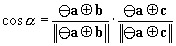
Let ? a ? b and ? a ? c be two nonzero rooted gyrovectors rooted at a common point a. in a gyrovector space ( G, ?, ?). The gyrocosine of the measure of the gyroangle ?, 0 ? ? ? ?, that the two rooted gyrovectors generate is given by the equation
| (8.2) | |
The gyroangle ? in (8.2) is denoted by ? = ? bac or, equivalently, ? = ? cab. Two gyroangles are congruent if they have the same measure.
The measure...