Analytic Hyperbolic Geometry: Mathematical Foundations and Applications
In this book we are interested in gyrocommutative gyrogroups since some of these give rise to gyrovector spaces, which are our framework for analytic hyperbolic geometry.
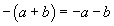
A gyrogroup ( G, +) possesses the gyroautomorphic inverse property if for all a, b ? G,
| (3.1) | |
A gyrogroup is gyrocommutative if and only if it possesses the gyroautomorphic inverse property.
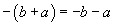
Proof. Let ( G, +) be a gyrogroup possessing the gyroautomorphic inverse property. Then the gyrosum inversion law (2.76) specializes, by means of (2.92), to the gyrocommutative law ( G6) in Def. 2.6, p. 24. Conversely, if the gyrocommutative law is valid then by the gyrosum inversion law,
| (3.2) | |
so that by eliminating the gyroautomorphism on both extreme sides and inverting the gyro-sign we have
| (3.3) | |
thus validating the gyroautomorphic inverse property.
Lemma 3.3 enables us to verify an interesting necessary and sufficient condition that a gyrogroup cooperation ? is commutative.
For any given b ? G, the self-map
| (3.4) | |
of a gyrogroup ( G, +) is surjective (that is, it maps G onto itself).
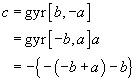
Proof. By the even property (2.92) of gyroautomorphisms, and by Lemma 2.32 we have
| (3.5) | |
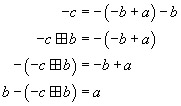
Hence, by inversion and by a right and a left cancellation, we have the following successive equivalent equations:
| (3.6) | |
so that for any given b ? G and for all