10.5 From Thomas Gyration to Thomas Precession
Thomas gyration is the missing link between Einstein addition and ordinary vector addition.
Einstein addition (10.3) forms the Einstein gyrogroup (  , ?). Hence, its gyrations gyr[ u, v] :
  are generated by Einstein addition according to the formula, Theorem 2.8(10),
| (10.6) | 
|
u, v,  . The velocity gyr[ u, v] w is said to be the velocity w gyrated by the gyration gyr[ u, v] generated by the velocities u and v. For u = v - 0 we have
| (10.7) | 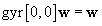
|
so that the gyration gyr[ 0, 0] is trivial, being the identity map of  .
.
It is clear from (10.6) that gyrations measure the nonassociativity of Einstein addition. Since Einstein addition of parallel velocities (3.150) is associative, gyrations generated by parallel velocities are trivial. Accordingly, one can show that
| (10.8) | 
|
for all  , whenever u and v are parallel in the ball
  of relativistic velocities.
Owing to the breakdown of associativity in Einstein velocity addition, the self-map gyr[ u, v] of the ball  is, in general, non-trivial. It turns out to be an element of the group SO(3) of all 3 3 real orthogonal matrices with determinant 1. Indeed, the map gyr[ u, v] can be written as a 3 3 real orthogonal matrix with determinant 1, as shown in [Ungar (1988a)].

 TABLE OF CONTENTS