Analytic Hyperbolic Geometry: Mathematical Foundations and Applications
In this chapter we uncover the link between gyrovector spaces embedded in the Euclidean n-space ? n, n ? 2, and differential geometry. Accordingly, we explore the differential geometry of M bius gyrovector spaces (
, ? M, ? M), Einstein gyrovector spaces (
, ? E, ? E), and PV gyrovector spaces ( ? n, ? U, ? U), where
is the c-ball of the Euclidean n-space,
| (7.1) | |
We will find that the differential geometry of M bius and Einstein gyrovector spaces reveals that M bius gyrovector spaces coincide with the Poincar ball model of hyperbolic geometry while Einstein gyrovector spaces coincide with the Beltrami (also known as the Klein) ball model of hyperbolic geometry. In contrast, PV gyrovector spaces seem to provide a new space (as opposed to ball) model of hyperbolic geometry.
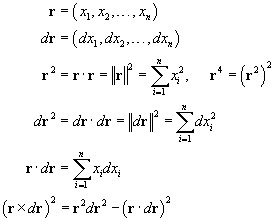
In ? n we use the vector notation
| (7.2) | |
noting that by the last equation in (7.2) ( r d r) 2 is defined in ? n for any dimension n.
To set the stage for the study of the gyroline and the cogyroline element of the gyrovector spaces (
, ?, ?) and ( ? n, ?, ?) in Sees. 7.3 7.8 we begin with the study of the Riemannian line element ds 2 of the Euclidean vector space ? n with...