10.6 The Relativistic Gyrovector Space
If integer scalar multiplication n ? v is defined in the Einstein gyrogroup (  , ?) by the equation
| (10.15) | 
|
for any positive integer n and  then it follows from Einstein addition law, (10.3), that
| (10.16) | 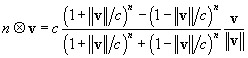
|
for any positive integer n and  . Suggestively, the scalar multiplication that Einstein addition admits in the relativistic velocity gyrogroup (
  , ?) is defined by the equation, (6.234),
| (10.17) | 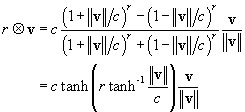
|
where r is any real number, r ? ?,  , v ? 0, and r ? 0 = 0, and with which we use the notation v ? r = r ? v.
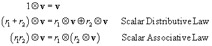
Einstein scalar multiplication turns the Einstein gyrogroup (  , ?) of relativistically admissible velocities into a gyrovector space (
  , ?, ?) that possesses the following properties.
for all real numbers r, r 1, r 2 ? ? and admissible velocities  .
.
Unlike vector spaces, the Einstein gyrovector space (  , ?, ?) does not possess a distributive law since, in general,
| (10.18) | 
|
for r ? ? and u,  .
.
Remarkably, the Einstein gyrovector space (  , ?, ?) of Einsteinian velocities with its gyrodistance function given by the equation
| (10.19) | 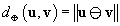
|
u,  , forms the setting for the Beltrami ball model of 3-dimensional hyperbolic geometry just as the vector space ( ? 3, +, ) of Newtonian velocities with its...

 TABLE OF CONTENTS