Analytic Hyperbolic Geometry: Mathematical Foundations and Applications
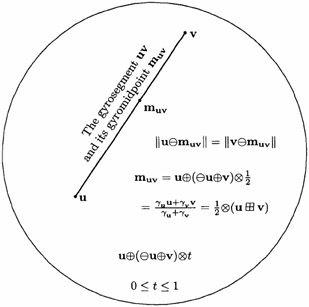
A point v in the Einstein gyrovector space (
, ?, ?), or the Einstein gyrovector plane (
, ?, ?) shown in Fig. 10.1, represents all the inertial frames ? v with relativistically admissible velocity v relative to a rest frame ? 0. Accordingly, the relativistic velocity of frame ? v relative to frame ? u is ? u ? v, and the relativistic velocity of frame ? u relative to frame ? v is ? v ? u. Remarkably, these two Einsteinian reciprocal velocities are not reciprocal in the classical sense since they are related by the identity
| (10.22) | |
that involves a Thomas precession. Identity (10.22) is obtained by employing the gyroautomorphic inverse property, Def. 3.1 and Theorem 3.2, of Einstein addition, according to which ?( a ? b) = ? a? b, and the gyro-commutative law of Einstein addition. The classical counterpart of (10.22), - u + v = -(- v + u), is known as the principle of reciprocity.