Artificial War: Multiagent-Based Simulation of Combat

Other than communicating their force-identity to nearby agents (i.e. providing other agents with a simple friend or enemy tag ), agents do not normally communicate any other kind of information to one another. However, more complicated scenarios including a rudimentary form of inter-agent communication can be defined.
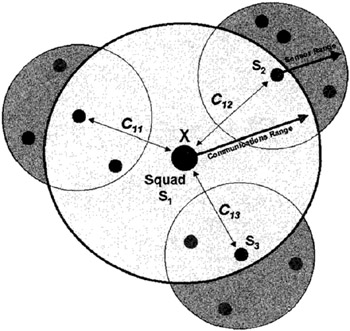
EINSTein provides options that allow agents to increase their effective sensor range by including battlefield data that is normally outside of their default sensor range in their local move-penalty calculation. This additional information about the location of friendly and/or enemy agents is provided via a notional communications link to nearby friendly agents.
Figure 5.34 illustrates the communications logic. All friendly agents Y within the communications range r C of agent X (positioned at the center of the figure) communicate to X the information contained within their own sensor range r S . This information consists of positions of friendly and enemy agents that are normally outside of X s sensor range. Agent X then incorporates this additional information into its penalty function by weighing all communicated information with a communication weight w Comm ? 0. The full penalty is defined by:
| (5.14) | |
where Z Penalty (0) is the communications-free penalty function defined earlier (see equation 5.3), and Z C is the same penalty function applied to communicated information.
If ? Comm = 0, X effectively ignores all communicated information; if ?