Artificial War: Multiagent-Based Simulation of Combat

In its simplest interactive run mode, EINSTein has only one notional squad, agents do not communicate with any other agents and all agents base their decisions on information that is strictly local to their sensor s field-of-view. While such a design is adequate for exploring the dynamical consequences of having a decentralized command and control (C 2) structure, any serious analysis tool of real combat must, of course, include some form of a functioning C 2 hierarchy.
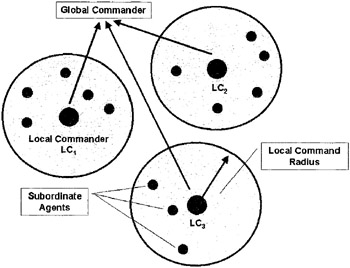
To this end, the user has the option of defining a notional command and control (C2) hierarchy within EINSTein. This hierarchy consists of three kinds of agents (see figure 5.51):
Elementary combatants: these are the individual agents as described in earlier sections, but are now thought of as subordinate agents to the local commander.
Local commanders: these are agents that command, and coordinate information flow among, local clusters of elementary combatants.
Global commanders: these are agents that have a global view of the entire battlefield, and coordinate the actions of the local commanders under their command.
Local and global command consists, essentially, of specifying local goals that subordinate agents must try to accomplish. These goals are defined using information derived from local command areas (inn the case of local command) or the entire battlefield (in the case of global command). One way in which, say, local commanders can issue orders...