Structure and Properties of Atomic Nanoclusters
Chapter 3: Van der Waals Clusters

3.1 Structure of Van der Waals Clusters

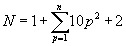
The mass spectrum of xenon clusters (Xe N) obtained by Echt, Sattler and Recknagel [1] is given in Fig. 3.1. It is apparent that the abundance varies in a rather peculiar way as a function of size N, and this behavior is the same each time the experiment is repeated. The abundance is not at all a monotonic function of size. Certain particular sizes are formed with high abundance, while the sizes following those abundant ones are, instead, especially rare. Main breaks at sizes N = 13, 55 and 147 are particularly noticeable. These, so called magic numbers, are elements of a series

(3.1)

with n = 1, 2 and 3, respectively. Further elements in the series are N = 309, 561 and 923, corresponding to n = 4, 5 and 6. This series describes the packing of spheres in a family of closed icosahedral arrangements, named after Mackay [2], and n gives the number of concentric atomic layers in the icosahedron. An icosahedron has 12 five-fold symmetry axes. It also has 20 triangular faces and each of these can be constructed with close-packed spheres. Atoms in the interior of the icosahedon are 12-fold coordinated, just as in a close-packed lattice. Figure 3.2 shows the first five perfect Mackay icosahedra ( n = 1 5 layers). In subsequent experiments [3] the same group was able to show that main abundance breaks also occurred in the...

UNLIMITED FREE
ACCESS
TO THE WORLD'S BEST IDEAS

SUBMIT
Already a GlobalSpec user? Log in.

This is embarrasing...

An error occurred while processing the form. Please try again in a few minutes.

Customize Your GlobalSpec Experience

Category: Mass Spectrometers
Finish!
Privacy Policy

This is embarrasing...

An error occurred while processing the form. Please try again in a few minutes.