5.7.1 Relation Between Theory and Experiment
The linear response theory can also be applied, within the DFT framework, to the case of the interaction between the cluster and a time dependent electric field characterized by a potential
| (5.27) | 
|
This leads to the time dependent Density Functional Theory [83 85]. The external field induces a time dependent perturbation of the electron density
| (5.28) | 
|
with Fourier components Sn( r; ?). The key quantity to calculate the response of the system in the linear regime is the dynamical susceptibility ?( r, r'; ?), which relates the individual components of the induced density to those of the external potential
| (5.29) | 
|
Again the main interest arises in the case of a dipole field. The dynamical polarizability ?( ?), which is the ratio between the induced dipole moment and the intensity of the applied field, becomes
| (5.30) | 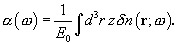
|
The dynamical polarizability reduces to the static one of Eq. (5.24) for ? = 0. Dissipation results in ?n( r; ?) being a complex function, and its imaginary part represents the power absorption of the cluster, that is due to electronic excitations. Using the Golden Rule, one obtains the photoabsorption cross section
| (5.31) | 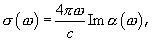
|
where c is the velocity of light and Im ?( ?) is the imaginary part of the dynamical polarizability.
Experiments have been performed to measure the photoabsorption spectrum. The experimental configuration [64, 86] is shown in Fig.


 TABLE OF CONTENTS