Structure and Properties of Atomic Nanoclusters

5.6: Response to a Static Electric Field

5.6 Response to a Static Electric Field

The net force acting on a cluster in the presence of a static (that is, time independent) inhomogeneous electric field E( r) can be expanded as

(5.19)

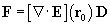
where ? n( r) = n( r) - n +( r), and n( r) and n +( r) are the electronic and ionic densities, respectively. The point r 0 can be identified with the cluster center. The first term in (5.19) does not contribute for a neutral system, and the second is the product of [ ? E]( r 0) times the induced dipole moment D. If the deformation of the ionic density due to the applied field is small, then the force on a neutral cluster is, in first order,

(5.20)

where the induced dipole moment can be written as D = ? E( r 0), that is, the product of the static polarizability ? and the applied field. The static polarizability measures the charge redistribution in the cluster when a static electric field is applied. The electric dipole polarizabilities of clusters of alkali metals [63, 64], aluminum [65] and semiconducting materials [66] have been determined by measuring the deviation from the original trajectory of a mass selected cluster beam that travels along the axis of a pair of electrodes which produce an inhomogeneous transverse electric field. Since the deflection ? z

UNLIMITED FREE
ACCESS
TO THE WORLD'S BEST IDEAS

SUBMIT
Already a GlobalSpec user? Log in.

This is embarrasing...

An error occurred while processing the form. Please try again in a few minutes.

Customize Your GlobalSpec Experience

Category: Ionizers and Static Eliminators
Finish!
Privacy Policy

This is embarrasing...

An error occurred while processing the form. Please try again in a few minutes.