Structure and Properties of Atomic Nanoclusters

Understanding the reactivity of metallic clusters is a complex subject. With regard to the reaction kinetics, there is a wide variability in reactivity in terms of the nature of the metal and the size of the cluster. Insight into the effects of the geometry and electronic structure on the reactivity can have tremendous impact on such diverse areas as thin film coating and catalysis
A concept used in discussing the reactivity of molecules is the Chemical Hardness ?, a quantity that can be measured as [49, 50]
| (5.15) | |
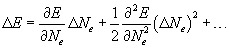
Its meaning can be understood by writing the change ? E in the energy of the molecule, or cluster, due to a small change ? N e in the number of electrons, maintaining the nuclei at fixed positions,
| (5.16) | |
The coefficient ?E / ?N e of the first term can be identified with the electronegativity, or chemical potential of the system (atom, molecule or cluster), and the coefficient
of the second term with its chemical hardness ? [50, 51]. Using a finite difference approximation to evaluate the derivatives in Eq. (5.16)
| (5.17) | |
where
is the number of electrons in the neutral species. The electronegativity is then given by ? = ( IP+ EA)/2 and the hardness ? by Eq. (5.15). ?, which measures the curvature of the function E( N), gives the resistance of the molecule or cluster to a change...