Structure and Properties of Atomic Nanoclusters
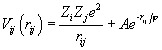
A salt like NaCl is composed of closed shell ions, Na + and Cl -, with electronic configurations similar to those of the rare gas atoms Ne (1 s 2 2 s 2 2 p 6) and Ar (1 s 2 2 s 2 2 p 6 3 s 2 3 p 6), respectively. The cohesion in the crystal is explained as a balance between attractive and repulsive forces between the ions. The attractive interaction comes from the Coulombic attraction between anions and cations, which tend to be nearest neighbors. In contrast, cation-cation and anion-anion repulsion prevents these from being nearest neighbors. Although the electrostatic interaction between anions and cations is attractive, the overlap between the closed electronic shells leads to a strong short-range repulsion arising from the Pauli exclusion principle, and sets a minimal distance of approach between nearest neighbors. These effects can be taken into account by an interionic potential of the form
| (10.1) | |
where r ij indicates the separation between two ions i and j. The second term represents the short-range repulsion between ions with closed electronic shells, and the first one is the long range Coulombic interaction (attraction or repulsion) between point charges of magnitudes Z ie and Z je ( Z i and Z j can be positive or negative). The parameters A and ? are usually determined...