Structure and Properties of Atomic Nanoclusters
Chapter 9: Magnetism

9.1 Some Basic Concepts

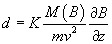
Since the clusters in a molecular beam are free from any interation with a matrix, it becomes possible to determine their intrinsic magnetic properties. The dependence of the magnetic properties on the cluster size can be determined in a Stern-Gerlach experiment, in which the clusters interact with an applied inhomogeneous magnetic field and are deflected from the original trajectory. The deflection of a cluster traveling with a velocity v transversally to the field gradient direction (defined as the z direction) is given by [1, 2]

(9.1)

where m is the cluster mass, ?B/ ?z is the magnetic field gradient and K is a constant which depends on the geometry of the apparatus. This equation indicates that the deflection is proportional to the cluster magnetization M( B). The experiments [1 8] are normally analyzed assuming that the ferromagnetic clusters are single-domain particles following the super paramagnetic behavior [9], which is true under conditions such that the thermal relaxation time is much lower than the time required by the clusters to pass through the poles of the Stern-Gerlach magnet [10]. In that case the atomic moments of a particle with N atoms are coupled by the exchange interaction, giving rise to a total magnetic moment ? N that is free of the cluster lattice. This orientational freedom allows the magnetic moment to align with an external magnetic field. For an ensemble of particles in thermodynamic equilibrium in...

UNLIMITED FREE
ACCESS
TO THE WORLD'S BEST IDEAS

SUBMIT
Already a GlobalSpec user? Log in.

This is embarrasing...

An error occurred while processing the form. Please try again in a few minutes.

Customize Your GlobalSpec Experience

Category: Magnetizers
Finish!
Privacy Policy

This is embarrasing...

An error occurred while processing the form. Please try again in a few minutes.