Structure and Properties of Atomic Nanoclusters

5.3: Temperature Dependence of the Ionization Potential

5.3 Temperature Dependence of the Ionization Potential

The experiments measuring IP are performed with the clusters at finite temperatures. Temperature leads to vibrations of the atoms, that is, to fluctuations of the cluster shape, and also to electronic entropy effects. The influence of the temperature on IP has been studied theoretically by Yannouleas and Landman [42] using a shell-correction method (see Section 4.3) corrected for finite temperature effects. The method incorporates several key ingredients: (1) static deformations of the cluster with respect to the spherical shape, (2) dynamic shape fluctuations due to temperature, and (3) electronic entropy. In this case the ionization potential is calculated as

(5.10)

where F( T, N, q = +1) and F( T, N, q = 0) represent the free energies of the ionized and neutral cluster at temperature T and the symbol ? ?indicates that the free energies are averaged over the shape fluctuations

(5.11)

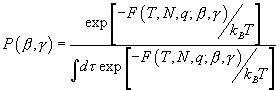
The parameters ? and ? specify the triaxial shape of the droplet. These are also used in nuclear physics, where they are called Hill-Wheeler parameters [43]. Equation (5.11) indicates that the cluster explores the free energy surface F( T, N, q; ?, ?) obtained by the finite temperature shell correction method with a probability

(5.12)

where the denominator is the partition function.

Yannouleas and Landman have compared the experimental ionization potentials of potassium clusters [27, 44] to calculations performed at

UNLIMITED FREE
ACCESS
TO THE WORLD'S BEST IDEAS

SUBMIT
Already a GlobalSpec user? Log in.

This is embarrasing...

An error occurred while processing the form. Please try again in a few minutes.

Customize Your GlobalSpec Experience

Category: Heat Exchangers
Finish!
Privacy Policy

This is embarrasing...

An error occurred while processing the form. Please try again in a few minutes.