Wave Scattering by Small Bodies of Arbitrary Shapes

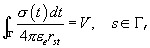
1. Suppose that the total charge of a conductor is Q and its potential is V. Then
| (3.1) | |
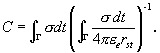
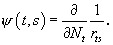
and the coefficient C is called the capacitance of the conductor. If ?( t) is the surface charge distribution, then
| (3.2) | |
and
| (3.3) | |
Thus
| (3.4) | |
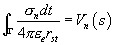
The function ?( t) can be calculated by the iterative processes given in Section 2.3 and Section 2.4. If ? n is an approximation to ? then the potential
| (3.5) | |
is not constant on ?. In this case we introduce the averaged potential
| (3.6) | |
If ? n ? ? in H = L 2( ?) then V n ? V and
| (3.7) | |
is an approximation to C. The iterative process (2.2) satisfies condition (2.3),
| (3.8) | |
In this case (3.7) can be written as
| (3.9) | |
where ? n is the n-th approximation to the solution of the problem
| (3.10) | |
and A is defined as usual (see (1.28)). One can construct ? n by means of the iterative process
| (3.11) | |
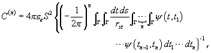
Theorem 2.2 and formula (3.9) imply the following theorem,
Let
| (3.12) | |
where S = meas ? and
| (3.13) | |
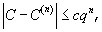
Then
| (3.14) | |
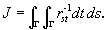
where c > 0 and 0 < q < 1 depend on the shape of the conductor but do not depend on n. The following inequality holds:
| (3.15) | |
where
| (3.16) | |
Proof. The first statement of...