Wave Scattering by Small Bodies of Arbitrary Shapes

A.4: Auxiliary Statements

A.4 Auxiliary Statements

We need the following known facts from the theory of quadrature and cubature formulas. These facts can be found, for example, in [75], [63], [21], [55].

Lemma A.4

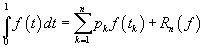
Let ? 1 be the class of functions , 1, 2, ..., 1 ? p ? ?, 0 ? t ? 1, f( t) ? ? 1, and the quadrature rule


be exact on all the polynomials of order up to p - 1, and has error R n( ? 1) on the class ? 1. Let ? 2 be the class of functions , r = 1, 2, ..., 1 ? p ? ?, a ? x ? b, and g( x) ? . Then the quadrature formula


has error R n( ? 2) on the class of functions ? 2 and


Theorem A.2

([75], ) Among quadrature formulas


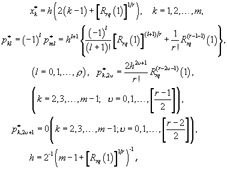
the best formula for the class (1 ? p ? ?) with ? = r - 1 and r = 1, 2, ?, or ? = r - 2 and r = 2, 4, 6, ?, is the unique formula defined by the following nodes and coefficients :


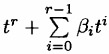
and R rq( t) is the Chebyshev polynomial , deviating least from zero in the norm L q(-1, 1), where p - 1 + q - 1 = 1.

UNLIMITED FREE
ACCESS
TO THE WORLD'S BEST IDEAS

SUBMIT
Already a GlobalSpec user? Log in.

This is embarrasing...

An error occurred while processing the form. Please try again in a few minutes.

Customize Your GlobalSpec Experience

Category: I/Q Modulators and I/Q Demodulators
Finish!
Privacy Policy

This is embarrasing...

An error occurred while processing the form. Please try again in a few minutes.