5.1 Calculating the Polarizability Tensor of a Solid Body
1. If a solid conductor is placed in an exterior homogeneous electrostatic field E, then the induced charge distribution ?( t) appears on its surface. Therefore the conductor acquires the dipole moment
| (5.1) | 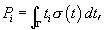
|
where t i is the ith coordinate of the radius vector t of the point t at the surface ? of the conductor. Since the equations of electrostatics are linear, there is a linear relation between P and E:
| (5.2) | 
|
(summation over the repeated indices is understood), where V is the volume of the conductor, ? e is the dielectric permittivity of the exterior medium, the matrix ? ij is called the polarizability tensor. The dipole moment is interesting in many applications, especially in scattering theory (see Chapter 7).
A more general definition of the dipole moment is as follows. Let ? 0 = -( E, x) be the potential of the exterior homogeneous field, ? = ? 0 + u be the potential of the total field. If the obstacle is finite, then
| (5.3) | 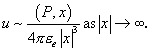
|
We assume here that the obstacle is electroneutral, that is, its total charge is zero. The vector P is called the dipole moment induced on the obstacle by the exterior field E.
2. Let the obstacle be a homogeneous body with dielectric constant ?.
Put
| (5.4) | 
|
The polarizability tensor is defined...


 TABLE OF CONTENTS