Applied Quantum Mechanics, Second Edition
Using real-world engineering examples to engage the reader, the author of this detailed text makes quantum mechanics accessible and relevant to the engineering student.
 TABLE OF CONTENTS
 For most of this book we have considered a single particle moving in a potential. In this chapter we will briefly examine the behavior of many identical particles. Our main focus will be to appreciate the statistical distribution function for large numbers of particles in thermal equilibrium.
The Hamiltonian for N particles subject to mutual two-body interactions is

where j > k in the sum avoids double counting. The corresponding multi-particle wave function obeys the Schr dinger equation

where ?( x 1, x 2, x 3, , xN, t) 2 dx 1 dx 2 dx 3 dx N is the probability of finding particle 1 in the interval x 1 to x 1 + dx 1, particle 2 in the interval x 2 to x 2 + dx 2, and so on. The key idea is that there is a single multi-particle wave function that describes the state of the N-particle system.
As it stands, this is a complex multi-particle, or many-body, problem that is difficult to solve. However, if we remove the mutual two-body interactions in Eq. (7.1) then the Hamiltonian takes on a much simpler form:
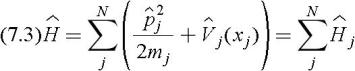
If the one-body potential V j( x j) is time independent, then the multi-particle wave function is a product

that satisfies the time-independent Schr dinger equation

We may now describe the system in terms of a product of N