Applied Quantum Mechanics, Second Edition

Using real-world engineering examples to engage the reader, the author of this detailed text makes quantum mechanics accessible and relevant to the engineering student.
 TABLE OF CONTENTS
 In classical mechanics the constants of motion of an isolated system are energy, linear momentum, and angular momentum. So far in this book we have not considered angular momentum. In this chapter we start by considering classical angular momentum and then proceed to find the corresponding quantum operators. Following this we consider a hydrogenic atom as a prototype application.
Suppose, as illustrated in Fig. 11.1, we have a point-particle of mass m, linear velocity v at instant t = 0, and momentum p = m v. Angular momentum L about a point r = 0 is defined as [1.]

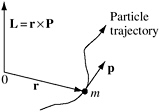
where r is the position of particle. Angular momentum is measured in units of J s.
This equation can be written in terms of angular velocity vector ?, normal to the plane of rotation, to give

Making use of the vector relationship a ( b c) = ( a c) b ? ( a b) c, the expression for L may be rewritten as

where the inertia tensor is

In Eq. (11.4) 1 is the unit matrix. If ? = ? n where n is the unit vector in the direction of ? then the...