Applied Quantum Mechanics, Second Edition

Using real-world engineering examples to engage the reader, the author of this detailed text makes quantum mechanics accessible and relevant to the engineering student.
 TABLE OF CONTENTS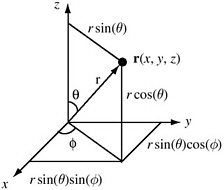
The position of a point particle in three-dimensional Euclidean space is given by the vector r( x, y, z) in Cartesian coordinates, where x, y, and z are measured in the x ~, y ~, and z ~ unit-vector directions, respectively. The Cartesian differential volume element is just dx dy dz. In spherical coordinates, the position vector is r( r, ?,  ), where r, ?, and are the radial and two-angular coordinates, respectively. The coordinate ? is the polar angle from the z-axis with 0 ? ? ? ?, and is the azimuthal angle in the x ? y plane with 0 ? ? 2 ?. The differential volume element is d 3 r = r 2 sin( ?) d d ?dr. The relationship between the two coordinate systems is given by
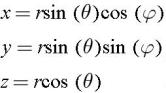
The value of r is related to Cartesian coordinates through

| Functions of real variable x | Hyperbolic functions of complex variable z |
|---|---|
| | |
| | |
| e ix = cos( x) + i sin( x) | |
| e ? ix = cos(x) ? i sin( x) | |
| cos 2( x) + sin 2( x) = 1 | cosh 2( z) ? sinh 2( z) = 1 |
| | |
| 2... |