Applied Quantum Mechanics, Second Edition
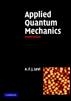
Using real-world engineering examples to engage the reader, the author of this detailed text makes quantum mechanics accessible and relevant to the engineering student.
 TABLE OF CONTENTS
 To understand and control the emission of photons from atoms or solids, we need to extend our knowledge to include something about the density of optical modes, light intensity, the background energy density in thermal equilibrium, Fermi s golden rule for optical transitions, the occupation factor for thermally distributed photons, and the Einstein  and
and  coefficients. In the next few pages, we explore these items by example. After completing this section, we will have the knowledge needed to consider the basic ingredients of a laser.
For electromagnetic plane waves characterized by wave vector k, the density of optical states in three-dimensions is

where the factor 2 is from the two orthogonal polarizations. This is the density of modes per unit volume in k-space. However, in a homogeneous nondispersive medium with refractive index n r, the wave vector k = n r ?/c and d k = n r d ?/c. Hence,


is the mode density. We will use this density of optical modes to calculate the background photon energy density at thermal equilibrium.
Notice that the density of optical modes in a medium with refractive index n r > 1is larger than that of free space, where n r = 1. The underlying reason for this is that light travels more slowly in the medium.
The Poynting vector S = E H