Applied Quantum Mechanics, Second Edition

Using real-world engineering examples to engage the reader, the author of this detailed text makes quantum mechanics accessible and relevant to the engineering student.
 TABLE OF CONTENTS
 Often there are situations in which the solutions to the time-independent Schr dinger equation are known for a particular potential but not for a similar but different potential. Time-independent perturbation theory provides a means of finding approximate solutions using an expansion in the known eigenfunctions.
As an example, consider the one-dimensional, rectangular potential well with infinite barrier energy shown in Fig. 10.1. The width of the well is L, and the potential energy is V( x) = 0 for 0 < x < L and V( x) = ? for 0 ? x ? L .
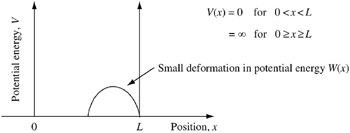
The time-independent Schr dinger equation for a particle of mass m in the potential V( x) is

The solutions to this equation have eigenfunctions

and eigenenergy
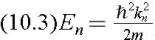
where
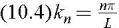
and the value of n takes an integer value so that n = 1 , 2 , 3 ,
We now suppose that the potential V( x) is deformed by the presence of an additional term W(