Applied Quantum Mechanics, Second Edition

Using real-world engineering examples to engage the reader, the author of this detailed text makes quantum mechanics accessible and relevant to the engineering student.
 TABLE OF CONTENTS
 Problem 8.1
In first-order time-dependent perturbation theory a particle initially in eigenstate n  of the unperturbed Hamiltonian scatters into state m with probability a m( t) 2 after the perturbation
  is applied.
Show that if the perturbation is applied at time t = 0 then the time dependent coefficient a m( t) is
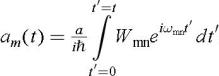
where the matrix element W mn =  mW( x, t) n and ? ? mn = E m ? E n is the difference in eigenenergies of the states m and n .
A particle of mass m 0 is initially in the ground state of a one dimensional harmonic oscillator. At time t = 0 a perturbation ( x, t) = V 0 x 3 e ?t / ? is applied where V 0 and ? are constants. Using the result in part (a), calculate the probability of transition to each excited state of the system in the long time limit, t ? ?.
Problem 8.2
An electron is in the ground state of a one-dimensional rectangular potential well for which V( x) = 0 in the range 0 < x < L and V( x) = ? elsewhere. It is decided to control the state of the electron by applying a pulse of...