Benchmarking Best Practices in Maintenance Management

This concise and easy to use book provides a framework for managing maintenance with options that allow decision makers to select the most successful ways to manage their businesses.
 TABLE OF CONTENTS
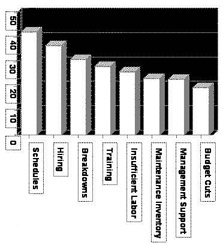
 A recent survey polled maintenance managers about their top problems. As Figure 6-1 illustrates, over 40% of the respondents indicated that scheduling was their biggest problem. Maintenance planning and scheduling is one of the most neglected disciplines today. This chapter will explore reasons for this lack of good planning and scheduling as well as some solutions to the problem.
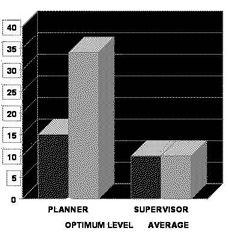
One of the major obstacles to maintenance planning and scheduling is management s reluctance to acknowledge that planners are essential to the program. In fact, Figure 1-3 (see Chapter 1) shows that two-thirds of maintenance organizations in the United States do not even have planners. However, Figure 6-2 shows a hidden problem. Even when organizations have planners, they place responsibility for too many craft technicians on them. Planners should be responsible for 15 (optimum) to 25 (absolute maximum) craft technicians. Supervisors then are responsible for over-seeing the work of an average of ten craft technicians. Why the difference between the two groups? This can best be answered by examining the job descriptions for the supervisor and the planner.
Chapter 3 discussed many of the responsibilities that make up a super-visor s job responsibilities. The following material looks more closely at how supervisors impact work execution.
Among the supervisor s responsibilities is seeing that the craft technicians they are assigned to supervise are fully motivated and ready to perform their jobs each day. This does not mean the supervisors must use a command-and-control...