Benchmarking Best Practices in Maintenance Management

This concise and easy to use book provides a framework for managing maintenance with options that allow decision makers to select the most successful ways to manage their businesses.
 TABLE OF CONTENTS
 If you ask a room of twenty people to write their definition of preventive maintenance, you will get twenty different answers. The term has varied definitions. For our purposes, we define preventive maintenance as any planned maintenance activity that is designed to improve equipment life and avoid any unplanned maintenance activity. In its simplest form, preventive maintenance can be compared to the service schedule for an automobile. Certain tasks must be scheduled at varying frequencies, all designed to keep the automobile from experiencing any unexpected breakdowns. Preventive maintenance for equipment is no different.
The reasons a preventive maintenance program is necessary are listed in Figure 7-1.
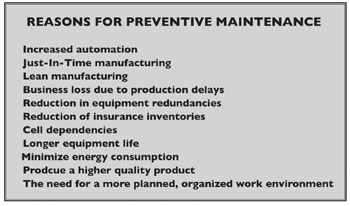
Increased automation in industry requires preventive maintenance. The more automated the equipment, the more components that could fail and cause the entire piece of equipment to be taken out of service. Routine services and adjustments can keep the automated equipment in the proper condition to provide uninterrupted service.
Just In Time manufacturing (JIT), which is becoming more common in the U.S. today, requires that the materials being produced into finished goods arrive at each step of the process just in time to be processed. JIT eliminates unwanted and unnecessary inventory. However, JIT also requires high equipment availability. Equipment must be ready to operate when a production demand is made; it cannot break down during the operating cycle. Without the buffer inventories (and high costs) traditionally found in U.S. processes, preventive maintenance is necessary to prevent equipment downtime. If equipment...